Protanomaly
The long-wavelength cone is shifted. Red looks darker and less saturated, and red and green move closer together. This is anomalous trichromacy: three cone types work, one of them differently.
Free tool
Six colour plates, each with a number in it. Someone with a red-green deficiency does not see some of them, or reads a different number. The test takes about two minutes, needs no signup and stores nothing. It is an indication, not a diagnosis: that needs an eye specialist with calibrated plates.
Set your screen to a normal brightness, sit at your usual distance, and turn off blue light filters, night mode and colour filters for the duration of the test. Those filters shift exactly the colours this test depends on.
Plate 1 is a practice plate. Its number is visible even when colour perception is limited. If you cannot read it, something is wrong with how the plates are being displayed, and the rest of the result says little.
The eye has three cone types, for short, medium and long wavelengths. In a red-green deficiency one of the two cones for red and green is missing or shifted in its sensitivity. The person does not see worse; they sort certain pairs of colours differently [3].
The long-wavelength cone is shifted. Red looks darker and less saturated, and red and green move closer together. This is anomalous trichromacy: three cone types work, one of them differently.
The same for the medium-wavelength cone. The most common form of all, and often so mild that a test is what reveals it.
The long-wavelength cone is absent. Red, orange, yellow and green collapse onto one axis, and red also looks noticeably dark.
The medium-wavelength cone is absent. As with protanopia two cone types remain, but the brightness of red stays close to normal.
In everyday speech all of this is called red-green colour blindness. Medically that only fits the second group, protanopia and deuteranopia, where a cone type really is missing. Complete colour blindness, where someone sees no colour at all, is something else and is very rare.
About 8 percent of men and about 0.4 percent of women of European descent have a red-green deficiency [1]. The National Eye Institute gives the same order of magnitude, around one in twelve men [2]. The cause sits on the X chromosome, which is why men are affected far more often than women.
On the left the plate as normal colour vision sees it. Beside it the same plate converted to the colour perception of deuteranopia and of protanopia. The conversion follows the method of Vienot, Brettel and Mollon [4]. A simulation shows which differences disappear; it is not a picture of how someone experiences the world.
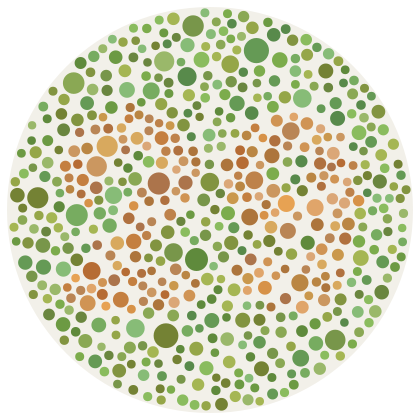
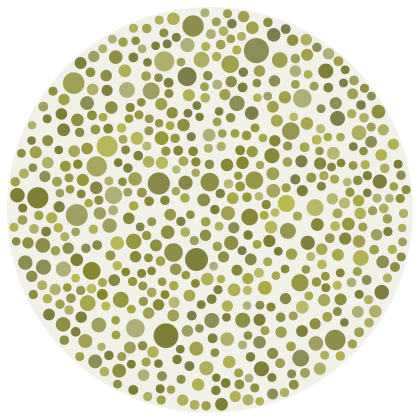
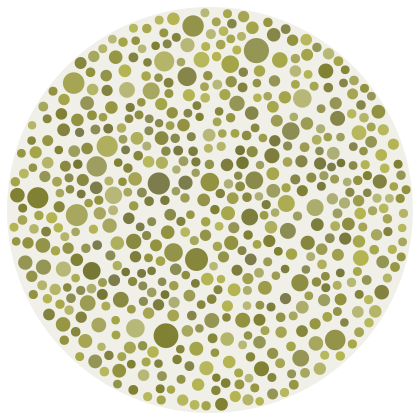
The limits of this test:
The same perception the plates rely on decides whether your website works. When information is carried by colour alone, part of your audience never receives it.
A red outline with no text beside it says nothing to part of your visitors. Success Criterion 1.4.1 Use of Color (Level A) requires that colour is not the only means [5].
Red and green lines with no labels, patterns or symbols are exactly the case the plates above imitate.
Green dot means fine, red dot means error: without a word or a symbol the meaning stays open.
Regardless of colour vision, 1.4.3 Contrast (Minimum) asks for at least 4.5:1 for normal text [6], and 1.4.11 asks for 3:1 for user interface components and meaningful graphics [7].
Our free check tests your page for contrast failures under 1.4.3 among other things, and for patterns that carry information by colour alone. It does not find everything: whether colour is the only carrier of a meaning can only partly be decided automatically, and the rest belongs in a manual review.
Our generator drafts it from what you enter, in the structure the law expects.
The free check tests one page against WCAG 2.1 AA and shows the most serious findings with the relevant legal reference. No signup.
This colour vision test is an indication and not a medical diagnosis. The plates are our own, built on the principle of pseudoisochromatic plates rather than taken from a clinical test book, and how they render depends on your screen. For an assessment, see an eye specialist. Inkluso is a tool for web accessibility and gives neither medical nor legal advice.